


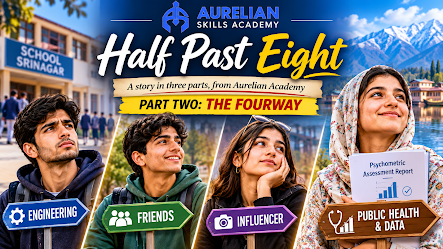
PART TWO: THE FOURWAY
In a school in Srinagar, four students sat the same examination in the same hall, under the same ceiling fan, with the same nervous hands.
Their marks were a few points apart. Then the hall emptied, and four roads opened.
The first road was chosen for him.
Zaid’s father was a government officer. He had settled his son’s future years ago, between one sip of tea and the next.
“Engineering.”
It was not a question. It was a weather report.
Zaid did not argue. Arguing felt like returning a gift after the giver had gone hungry to buy it. He packed his bag and took the flight to a college far from home.
In his second year, the equations began to slip through his fingers like water. But in the hostel corridors, another Zaid appeared. He could explain anything to anyone. Classmates came to his room at midnight and left understanding.
No one noticed. Least of all Zaid.
By his final year, he had stopped trying. He had learned the quietest lesson of all: that what he wanted did not matter.
On graduation day his father shook his hand, proud and puzzled. “Why do you look so tired, beta?”
Zaid smiled. It was the hardest thing he had done in four years.
The second road was followed because of friends.
Amir did not know what he wanted. He knew exactly whom he did not want to lose.
His three closest friends chose a course at a private university in another city. It took one evening and one group chat. Staying behind meant becoming a stranger in his own story.
So he followed, the way a leaf follows a current. Like a sheep follows the flock.
Within a year, two of the friends changed courses and found things they loved. They could leave, because the road had been chosen by their own hearts.
Amir’s road was borrowed. A borrowed road cannot be left, because it was never yours.
His mother called every Sunday. “Are you happy there?”
“Yes, mummy,” he said. It was a small lie, said so often that it began to feel like the truth.
The third road was taken alone, in a hurry.
Sana wanted none of it. Not the advice, not the opinions, not the sweets.
“I know what I want,” she said. “I will be a creator. An influencer. A traveler on screen. A name people know.”
There is courage in that sentence, and it is real. But courage without a map is only speed.
She did not know how the field pays, or how rarely. She did not know the skills it needs beyond a beautiful photograph. She did not know what happens at twenty-four when the algorithm looks away. When the dopamine stops.
Eighteen months later she came home quietly. Her phone was full of numbers, and her future was empty of options.
Her mother set a cup of tea in front of her and said nothing. Sana had expected anger. The kindness was harder to bear. An unexpected and unwanted gift.
The fourth road was walked with open eyes.
Aroofa stood at the same crossroads, with the same marks and the same fear.
But she carried a folded report, and the memory of a room where three people had finally told each other the truth.
Her family had expected medicine. In their minds it was the golden road, and no other road even had a name.
The report did not tell her to refuse it. It simply told the truth about her.
She was drawn to understanding problems and serving people, in equal measure. Her mind moved easily through patterns, numbers and language. She came alive in analysis and planning, and faded in long, unchanging routine.
The counsellor placed the family around one table. She did not dismiss medicine. She walked them through it honestly: its length, its cost, its daily reality, the temperament it rewards.
And for the first time, Bashir heard his daughter explain why she hesitated. It was not defiance. It was discovery. A miraculous blooming of a shy flower.
Then the counsellor opened a wider map: public health, health analytics, psychology, biostatistics. Doors none of them had known were there. They were hearing them for the first time.
Aroofa chose a road in public health and data. Her parents did not just allow it. They understood it, because they had seen the evidence with their own eyes.
Shaista touched her daughter’s cheek. “Now I can sleep.”
It was not a guaranteed road. No road is. But it was hers, and it was chosen in daylight.
What the four roads teach
Zaid was loved, but not heard. Amir was accompanied, but not known. Sana was free, but not informed. Aroofa was all three: heard, known and informed.
Notice that family, friends and independence are not the villains here. A parent’s love is a compass. A friend’s company is a comfort. A young person’s courage is a gift.
What failed three of these students was never who chose. It was that the choice was made in the dark.
Evidence did not take the decision from Aroofa’s family. It gave the decision back to them, in the light, ready to be owned.
